


Support Risk-Informed Development near Transmission Pipelines
Development near transmission pipelines may increase the potential for pipeline damage, impede access for pipeline maintenance and emergency response, and increase risks to people living and working near the pipeline rights-of-way.
- Implement PIPA recommended practices listed below from the PIPA Report, Partnering to Further Enhance Pipeline Safety In Communities Through Risk-Informed Land Use Planning.
- Raise local governments’ and property developers’/owners’ awareness and support their implementation of PIPA recommended practices.
- Understand pipeline risk. Read Building Safe Communities: Pipeline Risk and its Application to Local Development Decisions.
PIPA Tools for Pipeline Operators
Partnering to Further Enhance Pipeline Safety in Communities Through Risk-Informed Land Use Planning 
Building Safe Communities: Pipeline Risk and its Application to Local Development Decisions
Land Use and Development Near Transmission Pipelines: Checklist for Planning, Design, Communication, Permitting, and Site Plan Review 
Evaluation Worksheet for Transmission Pipeline Operators. This can be used to perform gap analyses comparing current related practices to the PIPA recommended practices.

Pipelines and Informed Planning Alliance. A brochure for all stakeholders regarding the PIPA Recommended Practices.
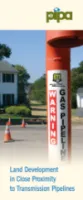
Land Development in Close Proximity to Transmission Pipelines. A brochure for local governments regarding the PIPA Recommended Practices.
Recommended Practices for Transmission Pipeline Operator
-
BL03 Utilize Information Regarding Development around Transmission Pipelines
Transmission pipeline operators should provide information about their pipelines to local governments and property developers/owners who are planning development around their pipelines. Local government authorities regulating development should use this information to establish requirements regarding land use and development around transmission pipelines.
-
BL08 Manage Land Records
Land use agreements between pipeline operators and property owners should be documented and managed and, when necessary, recorded.
-
BL09 Document and Record Easement Amendments
Easement amendments should be documented, managed and recorded.
-
BL10 Implement Communications Plan
Transmission pipeline operators should develop and implement effective communications plans when communicating acceptable transmission pipeline right-of-way uses and activities to property developers/owners and other stakeholders.
-
BL11 Effectively Communicate Pipeline Risk and Risk Management Information
Transmission pipeline operators should identify barriers to effectively communicating with stakeholders and use communication techniques designed to overcome those barriers and effectively engage stakeholders to communicate with them regarding pipeline risks and how the operator manages such risks.
-
BL12 Notify Stakeholders of Right-of-Way Maintenance Activities
Transmission pipeline operators should notify affected stakeholders of right-of-way maintenance activities, including vegetation management.
-
BL13 Prevent and Manage Right-of-Way Encroachment
Transmission pipeline operators should communicate in a documented and timely manner with property developers/owners to prevent or rectify unacceptable encroachments or inappropriate human activity within the transmission pipeline right-of-way.
-
BL14 Participate to Improve State Excavation Damage Prevention Programs
All pipeline safety stakeholders should participate in the work of organizations seeking to make improvements to state excavation damage prevention programs, especially efforts to reduce exemptions from participation in one-call systems.
-
BL15 Enhance Damage Prevention Practices near High-Priority Subsurface Facilities
Transmission pipeline operators should implement enhanced damage prevention practices within the transmission pipeline right-of-way to ensure that pipeline operators and excavators meet on-site prior to excavation activity near high-priority subsurface facilities.
-
BL16 Halt Dangerous Excavation Activities near Transmission Pipelines
Transmission pipeline operators should have procedures and established contacts with local enforcement personnel in order to act appropriately to halt dangerous excavation activities that may damage their pipelines and potentially cause an immediate threat to life or property.
-
BL17 Map Abandoned Pipelines
When a transmission pipeline operator abandons a transmission pipeline, information regarding the abandoned pipeline should be maintained and included in the information provided to the one-call center.
-
ND02 Gather Information for Design of Property Development near Transmission Pipelines
In designing a proposed property development the property developer/owner should use all reasonable means to obtain information about transmission pipeline facilities in the area of the proposed development.
-
ND04 Coordinate Property Development Design and Construction with Transmission Pipeline Operator
When property development is planned within the consultation zone (reference PIPA Recommended Practice BL05), the property developer/owner and the transmission pipeline operator should communicate to ensure possible impacts of pipeline incidents and maintenance needs are considered during development design and construction.
-
ND07 Define Blanket Easement Agreements When Necessary
Upon request by the landowner, a transmission pipeline easement agreement may be defined to an acceptable, reasonable, and safe width and explicit location. State statutes or local government regulations may require easements to be defined prior to the approval of rezoning, subdivision plats and development permits.
-
ND08 Collaborate on Alternate Use and Development of Transmission Pipeline Right-of-Way
Property developers/owners, local governments and transmission pipeline operators may collaborate on alternative use of the transmission pipeline right-of-way and related maintenance.
-
ND18 Consider Transmission Pipeline Operation Noise and Odor in Design and Location of Residential, Mixed-Use, and Commercial Land Use Development
Consider noise, odor and other issues when planning and locating developments near above-ground transmission pipeline facilities, such as compressor stations, pumping stations, odorant equipment, regulator stations and other pipeline appurtenances.
-
ND25 Contact Transmission Pipeline Operator Prior to Excavating or Blasting
Anyone planning to conduct excavating, blasting and/or seismic activities should consult with affected transmission pipeline operators well in advance of commencing these activities. Excavating and blasting have the potential to affect soil stability or lead to movement or settling of the soil surrounding the transmission pipeline.
-
ND26 Use, Document, Record and Retain Encroachment Agreements or Permits
Encroachment agreements should be used, documented, recorded and retained when a transmission pipeline operator agrees to allow a property developer/owner or local government to encroach on the pipeline right-of-way for a long or perpetual duration in a manner that conflicts with the activities allowed on the easement.
-
ND27 Use, Document and Retain Letters of No Objection and Conditional Approval Letters
Transmission pipeline operators may use, document and retain “letters of no objection” in agreeing to land use activities on or near a transmission pipeline right-of-way. Such land uses may or may not be temporary.
-
ND28 Document, Record and Retain Partial Releases
Partial releases may be used to allow some part of the transmission pipeline right-of-way to be released from certain easement conditions, and should be documented, recorded and retained.
Disclaimer: Links to web sites outside of the Department of Transportation (DOT) are offered for your convenience in accessing related information. Please be aware that when you exit the Office of Pipeline Safety (OPS) web site, the privacy policy stated on our web site may NOT be the same as that on other web sites. OPS takes no responsibility for and exercises no control over the organization, views, or accuracy of the information contained on their servers.