


Quick Facts:
- Aboveground storage tanks are used to store unrefined petroleum, petroleum products, and liquefied natural gas.
Overview:
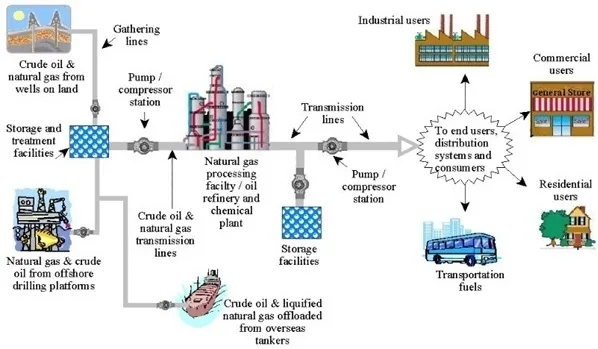
An example of a pipeline system
Aboveground storage tanks are an integral part of pipeline systems. In order to meet the demand for petroleum products and natural gas, both unrefined, unprocessed petroleum and natural gas, and refined products must be stored. This requires that storage capability be available near the production facilities (wellheads), at refining and processing plants, at loading facilities, and near distribution points.
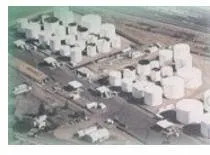
Aboveground storage tanks are constructed of steel plates and can hold large volumes of commodities. LNG storage tanks are normally spherical in shape to allow even distribution of pressure within the tank. Where large volumes of commodities must be stored, storage tanks are arrayed in what are referred to as tank farms. A typical example of a tank farm is shown at right.
Regulation of Above Ground Storage Tanks
The design, construction, and inspection of above ground storage tanks are regulated by 49 CFR Parts 192 and 195.
Above Ground Storage Tanks: Where can I learn more?
- PHMSA Community Liaison Services
- Code of Federal Regulations 49 CFR Part 192, Transportation of Natural Gas
- Code of Federal Regulations 49 CFR Part 195, Transportation of Hazardous Liquid by Pipeline
Date of Revision: 01112018